How AI is Reshaping Supplier Performance and Risk Management
Executive summaryModern supply chains are navigating a web of interconnected, high-velocity threats. Traditional, reactive procurement models are no longer sufficient. This article explores how Artificial Intelligence (AI) is transforming risk management from a descriptive function into a predictive strategic advantage — delivering verified ROI and operational resilience.
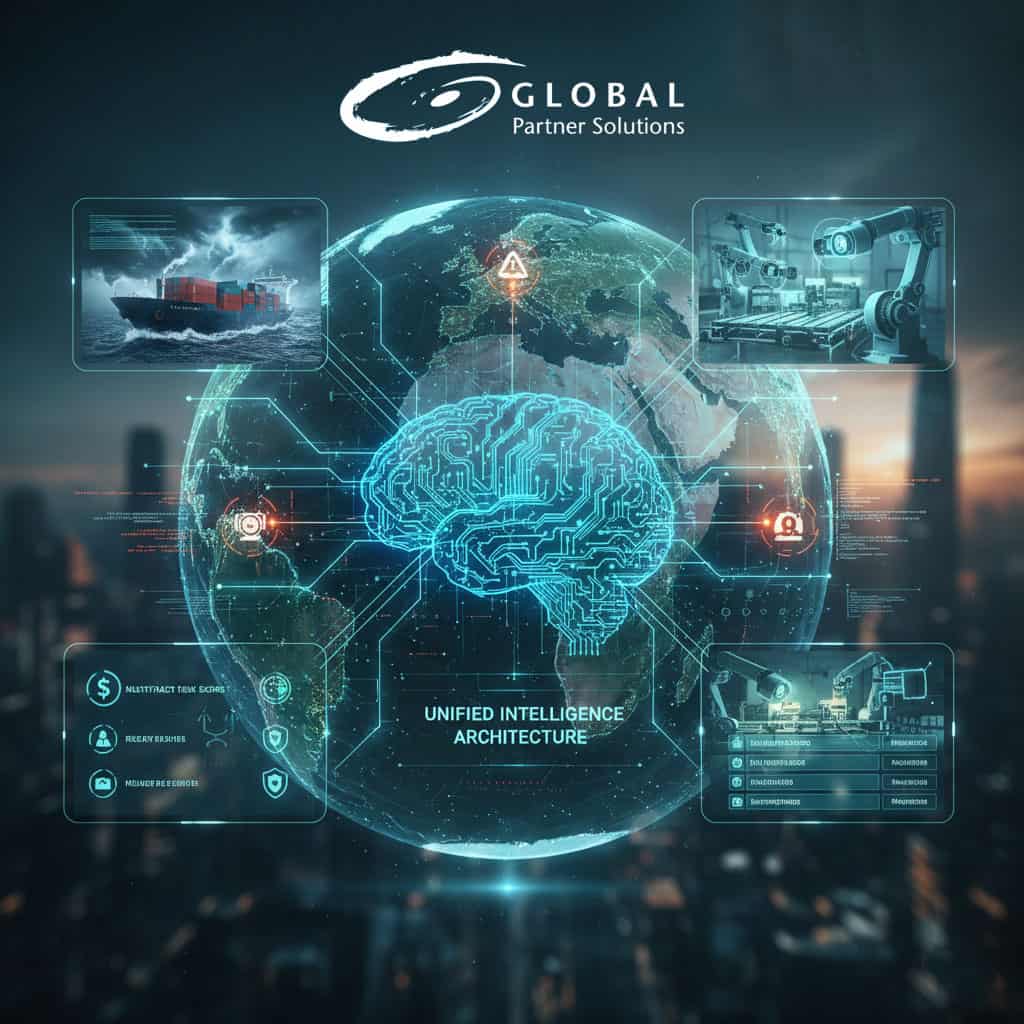
Predictive foresight: the shift AI enables from reactive triage — scrambling to respond after a disruption — to intervening before it, by integrating ERP, IoT, and external market data into a single “unified intelligence architecture.”
Key Takeaways
- 70% of CPOs report procurement risks are rising — yet many still use legacy, reactive tools.
- AI moves risk management from reactive triage to predictive foresight.
- It forecasts disruptions 48–72 hours in advance from weather, port, and traffic data.
- It builds a 360° view of supplier health — financial, geopolitical, and compliance signals.
- Computer vision replaces subjective quality reviews with objective, real-time defect detection.
- Early adopters see 2–5× ROI, 58% faster cycles, and up to 80% efficiency gains.
The New RealityWhy legacy models are failing
The operational landscape for procurement has shifted fundamentally. We have moved from a world of discrete risks to a multipolar environment defined by systemic fragility — where a regional conflict or cyber-attack cascades into global logistics failure.
of Chief Procurement Officers (CPOs) report that procurement risks are rising. Yet many organizations still rely on tools designed for a stable era.
- Spreadsheet-based tracking: creates data silos and bottlenecks.
- Subjective self-assessments: relies on biased supplier reporting.
- Periodic reviews: quarterly audits that miss real-time threats.
These legacy methods are not just inefficient; they are dangerous. They force organizations into a “wait and see” posture, scrambling to triage disruptions only after they have impacted the bottom line.
The Paradigm ShiftFrom triage to foresight
AI does not merely speed up existing processes; it rearchitects the risk management mindset, moving the discipline from reactive triage to predictive foresight. By integrating data from ERPs, IoT devices, and external market feeds, AI creates a “unified intelligence architecture.” The table below outlines this critical operational shift:
| Feature | Traditional (Pre-AI) approach | AI-driven predictive paradigm |
|---|---|---|
| Data source | Historical reports & self-assessments | Real-time sensors, geopolitical signals, market trends |
| Speed | Weekly or monthly manual aggregation | Continuous, “always-on” monitoring |
| Focus | Reactive response (post-disruption) | Proactive intervention (pre-disruption) |
| Scoring | Static, financial-heavy snapshots | Dynamic, multi-factor (ESG, cyber, geopolitical) |
In PracticeHigh-impact applications
The true value of AI lies in its specific applications. Below are three key areas where AI is reshaping supplier performance.
Predictive disruption forecasting
AI models analyze weather patterns, port congestion, and traffic data to forecast delays 48 to 72 hours in advance.
Holistic supplier health monitoring
Moving beyond simple credit checks, AI constructs a 360-degree view of supplier risk by scanning millions of data points, including:
- Financial distress: detecting slow invoice payments or cash-flow issues early.
- Geopolitical signals: flagging regional instability or labor strikes via news and social media analysis.
- Compliance: automating checks against regulations like the CSDDD and ESG standards.
Automated quality control (computer vision)
Computer Vision (CV) technologies are revolutionizing performance management. By installing CV-enabled cameras on production lines, organizations can:
- Detect product defects with superhuman accuracy.
- Trace defects instantly to their source.
- Replace subjective quarterly reviews with objective, real-time quality data.
Computer Vision (CV): AI that interprets images and video. On a production line, CV-enabled cameras inspect every unit in real time — catching and tracing defects far faster and more consistently than periodic manual review.
The Business CaseROI by the numbers
Investing in AI for supply chain risk is not a cost center; it is a value generator. Early adopters are already seeing significant financial impacts.
AI can unlock millions in working capital by optimizing payment terms and spend visibility — turning procurement from a reactive function into a measurable source of value.
AI is transforming risk management from a descriptive function into a predictive strategic advantage — delivering verified ROI and operational resilience. — How AI is Reshaping Supplier Performance & Risk Management
Frequently asked questions
How is AI changing supplier risk management?
Why are traditional supplier risk models failing?
What is predictive disruption forecasting?
How does AI monitor supplier health?
What is computer vision in quality control?
What ROI does AI deliver in procurement?
Related Case Studies
Supplier performance and risk, proven in the field.

45% Reduction in Non-Conformances
Read case study →
Supplier Recovery in 3 Months
Read case study →
Enhancing Supplier Performance in the Automotive Industry
Read case study →
A Long-term Successful Partnership
Read case study →Ready to make supplier risk predictive?
GPSI helps organizations modernize supplier performance and risk management — from real-time monitoring and predictive analytics to source inspection and recovery. Let’s find a time to connect.
Explore Supplier Performance Services Canada toll free: 866-980-1387 · US: 316-263-1288 · UK: 44 121 295 6504