The Role of Data & Analytics in Achieving Multi-Tier Supply Chain Visibility
Modern supply chains are more interconnected, volatile, and data-rich than ever before. Yet many companies still struggle to turn their data into meaningful visibility.
While most organizations collect enormous volumes of information across sourcing, procurement, manufacturing, logistics, and distribution, only a small fraction truly leverages that data to predict disruptions, improve efficiency, and manage multi-tier risks. As global supply chains become more complex and customer expectations rise, real-time visibility is no longer optional — it is a strategic capability, powered by the integration of data, analytics, and technology.
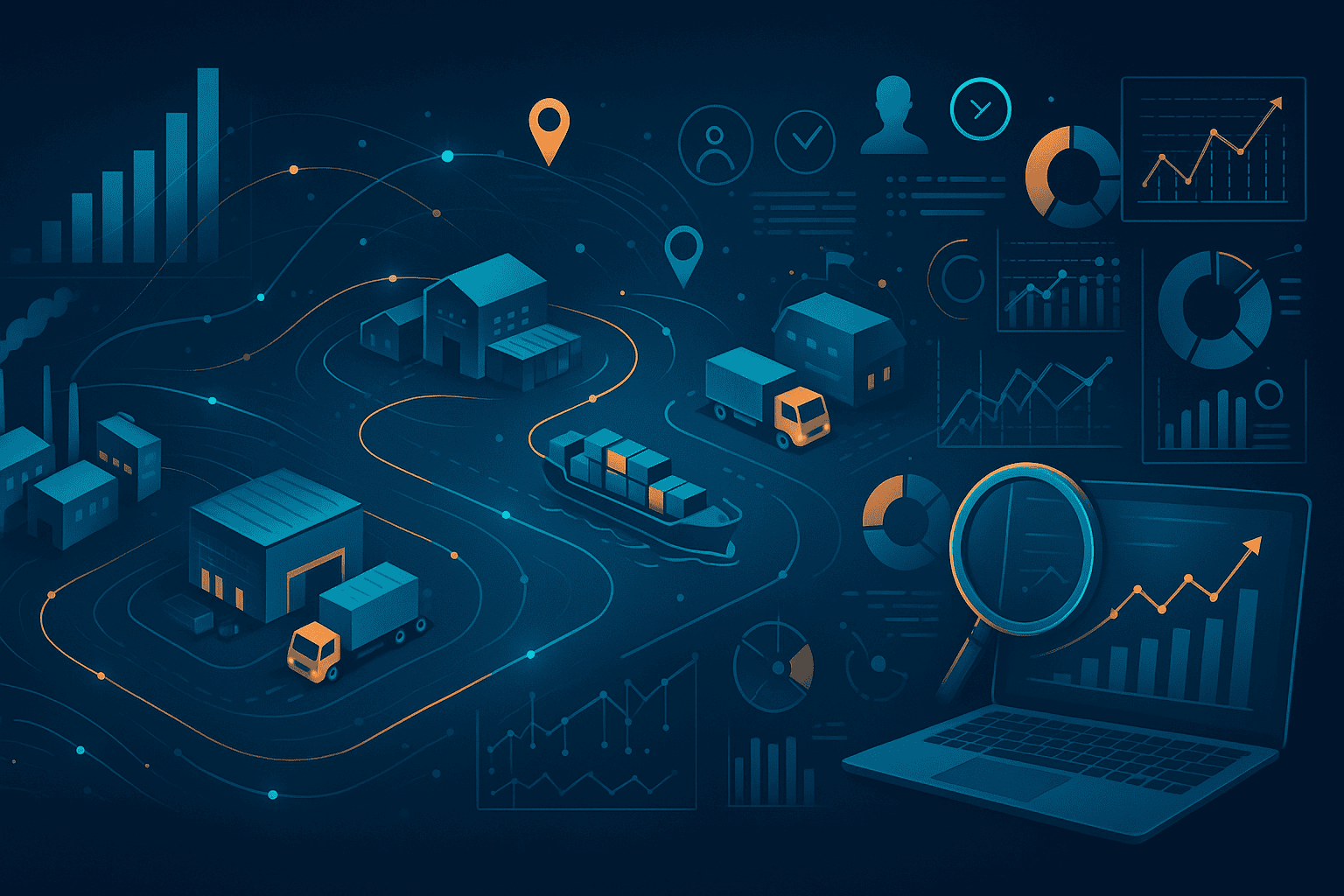
Multi-tier visibility: insight that extends beyond the Tier 1 suppliers you transact with directly — into Tier 2, Tier 3, and the dozens of upstream and downstream layers spanning raw materials, components, distribution, logistics, last-mile carriers, and customer delivery.
Key Takeaways
- Traditional visibility stops at Tier 1; multi-tier visibility sees the whole chain.
- Analytics turns data into insight in four stages: collect, integrate, model, visualize.
- The payoff spans visibility, efficiency, risk mitigation, cost, experience, and revenue stability.
- Key use cases: demand forecasting, inventory optimization, supplier monitoring, logistics, and resilience.
- Most teams are blocked by data silos, legacy systems, and manual spreadsheets.
- GPSI turns data into visibility through integration, analytics modernization, and risk mapping.
The ConceptWhat multi-tier visibility really means
Traditional supply chain visibility focuses on Tier 1 suppliers — the partners you transact with directly. But today’s supply chains extend far beyond that, involving Tier 2, Tier 3, and sometimes dozens of upstream and downstream layers. Multi-tier visibility provides insight into:
Visibility across every layer
From raw materials all the way to the customer’s door.
Achieving this level of visibility requires integrated data, real-time tracking tools, and analytics that reveal what is happening across the entire supply chain — not just the parts you directly control. This is why analytics is now at the center of modern supply chain performance.
The MechanicsHow supply chain data analytics works
Supply chain analytics connects data across all tiers and transforms it into actionable insight. The process typically includes four stages:
Data Collection
Gathered from ERP, WMS/TMS, supplier portals, IoT & telematics, carrier tracking, RFID, and manufacturing systems.
Integration & Cleansing
Data is standardized, de-duplicated, and merged into unified, reliable datasets.
Analytics & Modelling
Predictive models, statistics, machine learning, and optimization reveal patterns, risks, and opportunities.
Visualization & Reporting
Dashboards, alerts, KPIs, heat maps, and digital twins drive informed, rapid decisions.
Where the data comes from
Stage one pulls from across the operational stack.
The PayoffThe business benefits of multi-tier data & analytics
A clear line of sight from raw materials to customer delivery — material availability, supplier constraints, shipment status, inventory levels, production timelines, and logistics bottlenecks.
Analytics identifies inefficiencies, delays, bottlenecks, and waste, enabling companies to streamline operations and optimize resources.
Forecast supplier disruptions, delays, stockouts, demand swings, and transportation risks — acting ahead of problems instead of reacting to them.
Uncovers savings in inventory carrying costs, transportation spend, procurement waste, overtime and expedited shipping, and quality and compliance issues.
Real-time visibility ensures accurate ETAs, better delivery performance, and faster response during disruptions.
Strong visibility means fewer stockouts, fewer delays, and more reliable fulfillment — driving customer loyalty and revenue.
In PracticeKey use cases for supply chain analytics
Predicts customer demand using historical data, market trends, and algorithms.
Ensures the right inventory is in the right place at the right time.
Tracks delivery accuracy, lead times, quality, and compliance metrics.
Improves routing, reduces fuel costs, and accelerates delivery through predictive ETAs.
Identifies vulnerabilities and builds redundancy to improve recovery from disruptions.
The ToolkitTechnology enablers for multi-tier visibility
Leading companies rely on integrated tools that connect data across partners, geographies, and systems to create a unified operational picture:
- Real-time transportation visibility platforms — project44, FourKites, Shippeo, Descartes MacroPoint.
- End-to-end SCM platforms — Oracle SCM Cloud, SAP IBP, Infor Nexus, E2open.
- IoT and telematics for shipment and vehicle monitoring.
- RFID and barcode scanners for item-level tracking.
- Predictive analytics and AI for proactive decision-making.
- Blockchain for transparency and traceability.
- Cloud dashboards for cross-partner collaboration.
The ObstaclesWhy companies struggle to achieve visibility
Despite having access to more data than ever, most supply chain teams still face:
- Data silos across departments and suppliers
- Inconsistent data formats
- Lack of real-time data feeds
- Limited analytics capabilities
- Reliance on manual spreadsheets
- Low partner-to-partner integration
- Legacy systems that don’t communicate
GPSI’s ApproachTurning data into real multi-tier visibility
GPSI partners with organizations to transform their supply chain data into a strategic advantage — helping them evolve from reactive operations to predictive, proactive supply chain leaders. Our approach includes:
We connect data across suppliers, logistics providers, systems, and technologies to build a comprehensive visibility layer.
Predictive analytics, dashboards, performance monitoring, and KPI tracking that give leaders real-time, actionable insight.
We evaluate and implement best-fit platforms — project44, FourKites, Shippeo, Oracle, SAP, Infor Nexus, or others.
We help identify upstream risks across suppliers and develop mitigation strategies.
We use analytics to streamline procurement, planning, inventory, logistics, and fulfillment.
We help build data-driven supply chain strategies that drive resilience, agility, and long-term competitiveness.
ConclusionThe future of supply chain performance is data
Multi-tier visibility — supported by integrated systems, advanced analytics, and real-time tracking — gives companies the accuracy, confidence, and resilience required to operate in an uncertain world. Companies that embrace data-driven visibility will outperform their competitors in efficiency, cost, agility, risk management, and customer satisfaction.
The future of supply chain performance will be defined by data — transparent, intelligent, and ready for whatever comes next. — The Role of Data & Analytics in Multi-Tier Visibility
ReferenceMulti-tier visibility & analytics summary
| Category | What it includes | Business impact |
|---|---|---|
| Data collection | ERP data, WMS/TMS data, supplier feeds, IoT sensors, telematics, RFID, carrier tracking, production systems | Captures real-time information across every tier of the supply chain |
| Data integration & cleansing | Standardization, de-duplication, data validation, partner-to-partner integration | Eliminates silos, ensures data accuracy, builds a unified source of truth |
| Predictive analytics | Forecasting, disruption prediction, lead-time analytics, supplier risk modeling | Anticipates delays, shortages, risks, and demand shifts before they occur |
| Visibility platforms | project44, FourKites, Shippeo, MacroPoint, SAP IBP, Oracle SCM, Infor Nexus, E2open | Provides real-time tracking, predictive ETAs, and multi-tier transparency |
| Real-time monitoring | IoT tracking, condition sensors, GPS, vehicle telemetry, warehouse scans | Enables live visibility of materials, shipments, and inventory movement |
| Inventory optimization | Safety stock modeling, demand forecasting, replenishment analytics | Reduces stockouts, lowers carrying costs, improves product availability |
| Supplier performance analytics | Lead-time tracking, quality metrics, on-time delivery, compliance scoring | Strengthens supplier reliability and reveals early warning signals |
| Logistics & transportation analytics | Route optimization, cost modeling, carrier performance, mode analytics | Reduces transportation cost and improves delivery speed & accuracy |
| Blockchain traceability | Immutable record of supplier and material data | Enhances transparency, compliance, and product authenticity |
| Collaboration & cloud dashboards | Shared portals, real-time KPI dashboards, alerts, partner visibility | Improves cross-tier communication and decision-making |
| Risk & resilience analytics | Scenario planning, disruption mapping, redundancy modeling | Builds a more resilient, disruption-ready supply chain |
| GPSI’s role | Data integration, analytics modernization, visibility tech assessment, multi-tier risk mapping | Transforms raw data into actionable visibility and strategic advantage |
Frequently asked questions
What is multi-tier supply chain visibility?
How does supply chain data analytics work?
What are the business benefits of multi-tier analytics?
Why do companies struggle to achieve visibility?
What technologies enable multi-tier visibility?
Sources & further reading (21)
Related Case Studies
Supply chain visibility and logistics in action.

Supply Chain Assistance — 80,000 Parts Tracked in 6 Months
Read case study →
1,300 Truckloads Delivered in 9 Months
Read case study →
Supply Chain Improvement
Read case study →
Supply Chain Relocation — 9,000 Parts Repatriated and Re-sourced
Read case study →Ready to turn your data into real visibility?
GPSI integrates data, modernizes analytics, and deploys best-fit visibility platforms across every tier of your supply chain — so you can move from reactive to predictive. Let’s find a time to connect.
Explore Supply Chain Services Canada toll free: 866-980-1387 · US: 316-263-1288 · UK: 44 121 295 6504