
What are the Sustainable Priorities in 2023?
 Shantala HickeyDirector, ESG Division, GPSI
Sustainability is the trendiest topic for businesses across industries in 2023 — improving quality of life, preserving natural resources, and protecting the ecosystem. The question is how the corporate world can play its role.

Most companies fail to implement a sophisticated, long-term strategy to overcome environmental, social, and governance (ESG) challenges — so there is a need for a thorough, holistic approach to creating a safe and livable future. Sustainable practices also streamline operations and reduce long-term energy costs: energy-efficient lighting and wind or solar power can lower monthly utility bills.
Key Takeaways
- Sustainability is critical for businesses in all industries to identify and resolve environmental, social, governance, and economic problems.
- Implementing a sustainable model requires engaging all stakeholders and developing evidence-based frameworks and strategies.
- Transparency is essential to build and maintain stakeholder trust — through measurement and reporting on ESG elements.
At a GlanceSustainable priorities for 2023
| Sustainable priority | Key insights | Value to businesses |
|---|---|---|
| Climate change mitigation | Reducing carbon footprint, adopting renewable energy. | Enhances reputation and regulatory compliance. |
| Circular economy | Reuse, recycle, and minimize waste. | Lowers costs and improves resource efficiency. |
| Supply chain sustainability | Ethical sourcing and transparent operations. | Builds trust and ensures long-term viability. |
| Social responsibility | Promoting fair labour practices and community engagement. | Strengthens brand image and employee retention. |
| Technology & innovation | Leveraging digital tools for efficiency and sustainability. | Drives growth and competitive advantage. |
Priority 01Climate change mitigation
Per the IPCC assessment report, global temperatures increased about 1.1°C (1.98°F) between 1901 and 2020. Climate change affects everything humans depend upon — energy, water, wildlife, transportation, ecosystems, agriculture, and health — and its effects are uneven, with underserved groups and lower-resource countries more vulnerable. Companies must substantially reduce their carbon footprint to help create a more sustainable future.

Use sustainable procurement, second-hand or refurbished equipment and furniture, and cut food waste — food in landfills generates methane, which is 80× more potent than CO2. Consider composting and local sourcing.
Switching to renewable energy is one of the fastest ways to cut your footprint. Use green energy contracts and source from hydroelectric, solar, and biomass — the more sign-ups, the more clean energy returns to the grid.
Per the IEA, remote work reduces emissions despite higher home energy use, since commuting by car generates significant emissions. Adopting it helps cut your overall carbon footprint.
Priority 02Circular economy
A circular economy decreases waste and pollution through repair, reuse, and reduction, while restoring natural systems and supporting regeneration. It keeps resources in the loop longer — helping businesses avoid emissions from making new products while flourishing through ESG initiatives (per IMPACX). Here are the steps to prioritize a circular economy.
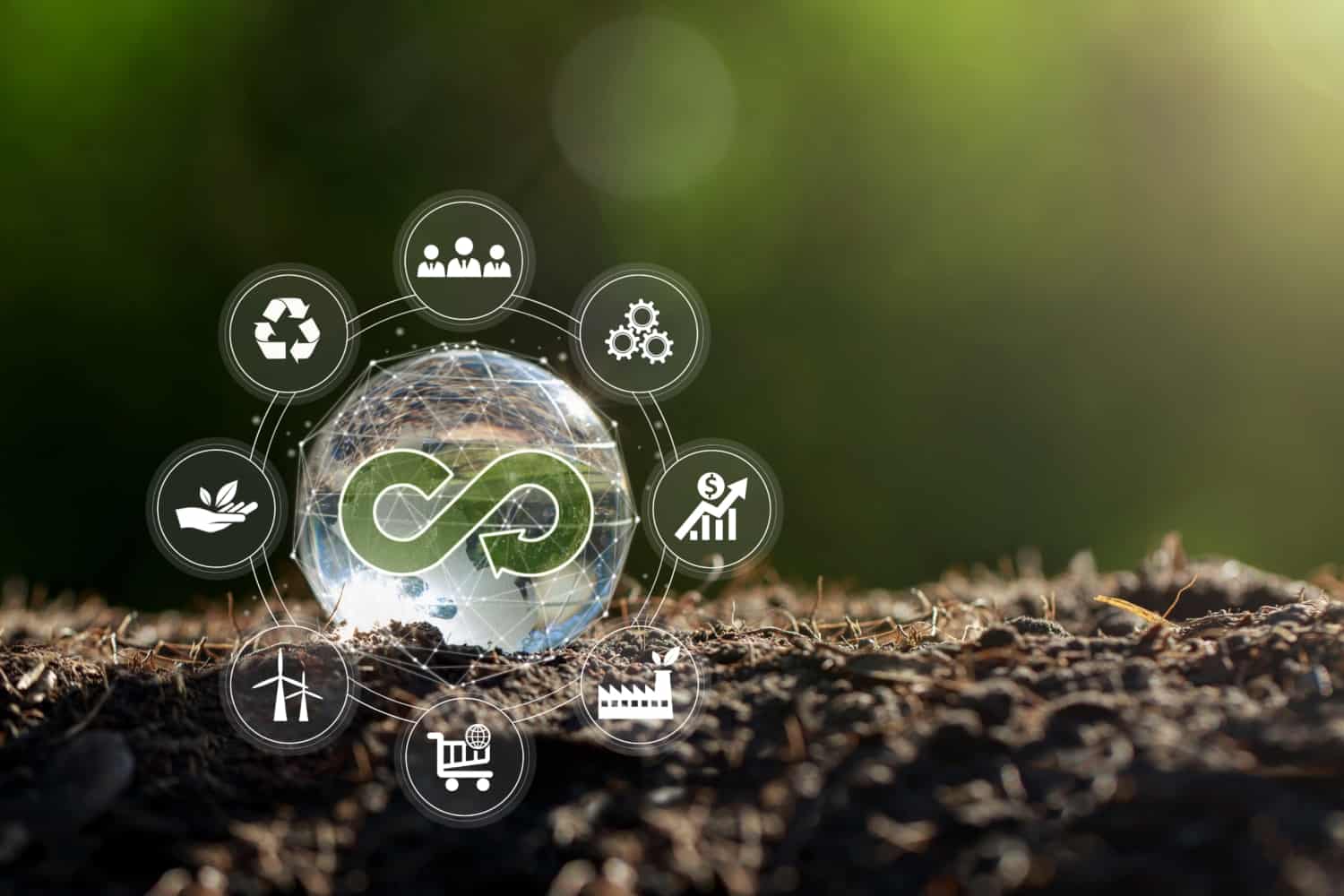
Assess your current situation to identify problem areas — analyzing production processes, supply chain, and waste management practices.
Design for efficiency, reliability, quality, and longevity — creating easy-to-repair, recyclable, and reusable products at end of life.
Use and reuse resources for an extended period through recycling, refurbishing, or repurposing materials and products.
Train employees on sustainable practices, communicate benefits to customers, and incentivize sustainable behaviour to build a lasting culture.
Priority 03Supply chain sustainability
A sustainable supply chain improves productivity and streamlines operations — boosting efficiency, reliability, and profitability while reducing risk and saving money. Nike, for example, adopted a sustainable supply chain model with measurable results:

Use eco-friendly transport and distribution — electric or hybrid vehicles, optimized delivery routes, and reduced packaging waste.
Source from certified suppliers using renewable energy and recycled materials, under a supplier code of conduct covering work safety, labour, environment, and ethics.
Design recyclable and reusable products, reduce packaging waste, and implement a waste-reduction program in your manufacturing facility.
Measure & report on performance
- Identify key metrics — carbon footprint, water usage, waste generated, and supplier ESG performance (scorecards, rankings, ratings).
- Collect and analyze historical and real-time data.
- Report findings concisely, clearly, and transparently.
- Set goals based on findings.
Priority 05Technology and innovation
Technology improves efficiency, reduces environmental impact, and promotes sustainable practices — from smart building systems with automatic lighting and heating to blockchain for traceability and transparency in supply chains. It also lets companies collect and analyze real-time sustainability data to improve measurement and reporting.

- Renewable energy systems
- Rainwater harvesting techniques
- Paper-free operations
- Biodegradable plastic
- Environmentally friendly equipment
- Electric vehicles
- Wireless power transfer
- Energy-efficient data centres
- IoT devices for tracking energy consumption
Choosing the right technologies means identifying your goals, evaluating operations, and considering scalability and stakeholder engagement. Per the Department of Energy, energy-efficient LED lighting is set to replace incandescent bulbs and reach an 84% market share by 2030.
Final WordsSustainability is no longer optional
Businesses that fail to adopt, implement, and maintain a sustainable strategy may not survive in the future. The global community is increasingly concerned about social responsibility and environmental issues, and consumers demand sustainable products and services.
Sustainability offers numerous benefits — from cost saving to reducing waste to achieving efficiency and improving the bottom line. The path forward is an evidence-based, holistic strategy. — Shantala Hickey, Director, ESG Division
Frequently asked questions
What are the sustainable priorities for businesses in 2023?
How can businesses reduce their carbon footprint?
What is a circular economy and how do you implement it?
How do you make a supply chain more sustainable?
How does technology support sustainability?

Shantala joined GPSI’s team in 2022, following her post-graduate diploma in Environmental Management. She is responsible for the ESG Division and the corporate social responsibility strategy. Before joining GPSI, she held several management positions at Bombardier Aerospace as well as Galderma, a company operating in the pharmaceutical and cosmetics industry. She has more than 15 years of experience in procurement, logistics, and production planning. The environment and sustainable development are undoubtedly her greatest passions.
Related Work
Sustainability and ESG work from the GPSI practice.

Giolong International — Integrating Sustainability into the Supply Chain
Read case study →
Reshoring: Why Is It Being Considered Today, and What Does It Involve?
Read article →
Integrating CSR into the Supply Chain
Explore supply chain sustainability →Build your sustainability strategy
GPSI’s ESG & Sustainability division helps companies integrate social responsibility into their strategy and improve the sustainability of their supply chains. Let’s find a time to connect.
Explore Our Approach to Sustainability Canada toll free: 866-980-1387 · US: 316-263-1288 · UK: 44 121 295 6504



















Priority 04Social responsibility
Corporate social responsibility is integral to a sustainable strategy — conducting operations ethically while addressing social, economic, cultural, and environmental issues. The stakes are measurable:
The seven ISO 26000 principles
Create an inclusive, respectful culture regardless of background, religion, language, or identity — diversity training, inclusive hiring, employee resource groups, and equal opportunities for advancement.
Implement transparent labour standards and codes of conduct, audit against them, and provide healthy working conditions, fair wages, and benefits — including supply chain teams.