The Strategic Advantage of Talent Outsourcing
How Companies Build Stronger Teams While Reducing Cost and Complexity

Finding, attracting, and managing talent has never been more challenging. Competition for skilled workers is high, roles are becoming more specialized, and HR teams are under pressure to deliver results with fewer resources. For many organizations, partnering with a talent outsourcing provider has become a powerful way to scale teams, fill skills gaps, and improve hiring outcomes while reducing operational burden.
Talent outsourcing allows companies to shift recruiting, sourcing, onboarding, or entire workforce functions to experienced external partners—unlocking efficiency, agility, and access to expertise.
Every organization today must navigate a complex environment shaped by economic uncertainty, rapid technological change, and evolving workforce expectations. To remain agile, businesses are no longer relying on just one type of worker. Instead, they build a blended workforce: full-time employees for core work, contractors for specialized expertise, and outsourced teams for scalable, ongoing functions.
Every organization today must navigate a complex environment shaped by economic uncertainty, rapid technological change, and evolving workforce expectations. To remain agile, businesses are no longer relying on just one type of worker. Instead, they build a blended workforce: full-time employees for core work, contractors for specialized expertise, and outsourced teams for scalable, ongoing functions.
Permanent employees sit at the heart of an organization. They safeguard institutional knowledge, contribute to culture, and support mission-critical activities. They are hired directly onto the payroll, receive benefits, and play a key role in long-term strategy and growth.
When this model works best:
For essential, ongoing responsibilities that require deep alignment with the company’s mission, confidential information, and long-term commitment.
| Benefits (The “Why”) | Challenges (The “Risks”) |
| Deep Expertise: Teams have a native understanding of the product and company culture. | High Total Cost of Ownership: Expensive when factoring in benefits, taxes, and infrastructure. |
| High Level of Control: You have direct authority over priorities, quality, and daily output. | Slow Hiring Timelines: Finding the right talent and onboarding them can take months. |
| IP Protection: Keeping proprietary information within your own firewalls reduces leak risks. | Low Economic Flexibility: Fixed overhead makes it difficult to scale down during a market dip. |
Contractors offer fast access to expertise without long-term commitment. They are ideal for high-skill, short-duration projects—especially in areas like AI, digital transformation, data science, engineering, or compliance.
They operate independently, manage their own taxes and benefits, and work under a defined scope of work.
When this model works best:
For short-term initiatives requiring specialized expertise that the company does not need to retain permanently.
| Benefits (The “Why”) | Challenges (The “Risks”) |
| Immediate Access: Rapidly plug in niche skills or specialized expertise without long training periods. | Limited Control: Legal restrictions often prevent you from managing contractors like employees. |
| High Scalability: Easily ramp up for a project or scale back when the work is complete. | Knowledge Loss: Valuable institutional knowledge exits the company when the contract ends. |
| Lower Commitment: No long-term costs like 401k, health insurance, or severance pay. | IP Risks: Requires robust legal frameworks to ensure confidentiality and data protection. |
Outsourcing shifts responsibility for an entire business function—such as customer service, HR operations, talent acquisition, payroll, or IT support—to a specialized external provider. Instead of hiring individuals, the company engages a complete system, supported by the vendor’s technology, expertise, and quality controls.
When this model works best:
For standardized, non-core functions where external specialists can deliver better performance at lower cost.
| Benefits (The “Why”) | Challenges (The “Risks”) |
| Cost & Efficiency: Leverages economies of scale and optimized workflows to reduce operational spend. | Loss of Control: You relinquish daily managerial oversight to the vendor’s leadership. |
| Advanced Tech: Gain immediate access to high-end infrastructure and experts without the R&D costs. | Governance Costs: Significant time and money must be spent on managing the vendor relationship. |
| Accuracy & Compliance: Vendors often provide Service Level Agreements (SLAs) that guarantee high standards. | Communication Hurdles: Differences in time zones, language, or corporate culture can cause friction. |
| Criteria | Permanent Employee | Contractor | Outsourced Team |
| Best For | Core functions & long-term knowledge | Short-term specialized skills | Non-core, high-volume processes |
| Cost Structure | High fixed cost + benefits | Variable project or hourly cost | Contract-based service fees |
| Managerial Control | Highest | Limited by law | Lowest; governed by SLAs |
| Key Advantage | Protects IP and builds culture | Fast access to expertise | Efficiency, cost savings, and scale |
| Main Risk | Expensive during downturns | Misclassification risk | Governance and communication overhead |
The strongest organizations blend these three models to build a workforce that is resilient, scalable, and ready for change.
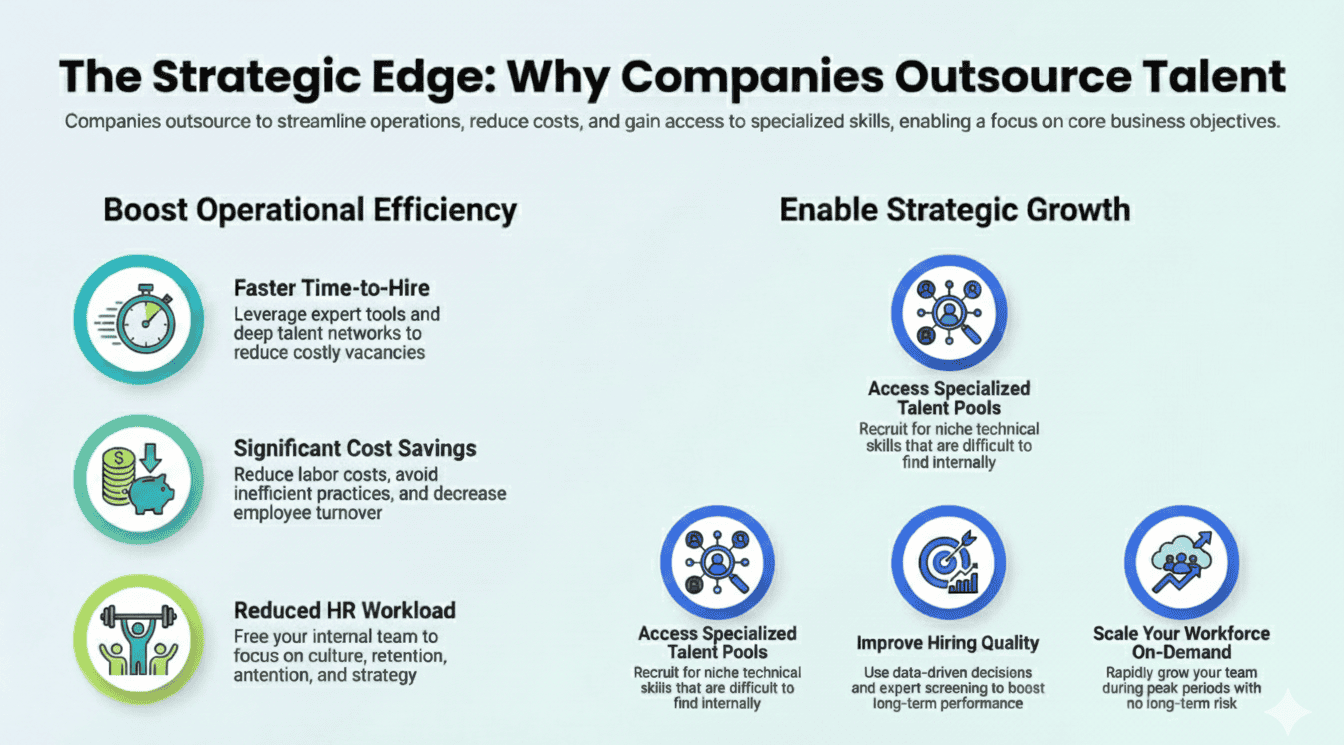
Talent outsourcing eliminates repetitive administrative tasks and frees internal teams to focus on organizational culture, retention, and workforce strategy.
Outsourcing partners use advanced sourcing tools, deep talent networks, and industry-specific expertise to accelerate hiring cycles and reduce vacancy costs.
By outsourcing recruiting and talent operations, companies reduce labor costs, avoid inefficient hiring practices, and decrease turnover. Outsourced partners also optimize processes that would otherwise require expensive internal resources.
External partners offer access to diverse candidate networks, technical talent, supply chain specialists, and niche skills that may be difficult to recruit internally.
Expert interview processes, advanced screening tools, and data-driven decision-making improve talent quality and long-term performance.
Organizations can rapidly scale their workforce during peak periods or growth initiatives—with no long-term employment risk.
The future of work depends on workforce elasticity—the ability to scale talent up or down with precision. No single hiring model fits every need. Instead, successful organizations combine permanent employees, contract specialists, and outsourced teams to build a workforce that is strong at its core, flexible at its edges, and able to respond quickly to new challenges.
Talent outsourcing empowers companies to operate more efficiently, access better talent, and stay competitive in a world where speed and adaptability determine success. With the right approach—and the right partner—organizations can build a resilient workforce ready for the future of work.
| Source / Organization | Link |
| Deloitte – Global Human Capital Trends | https://www2.deloitte.com/us/en/insights/focus/human-capital-trends.html |
| McKinsey – The Agile Workforce and Talent Models | https://www.mckinsey.com/capabilities/people-and-organizational-performance/our-insights/the-organization-blog/building-the-agile-workforce |
| Gartner – HR Outsourcing & Workforce Strategy | https://www.gartner.com/en/human-resources |
| Society for Human Resource Management (SHRM) – Outsourcing HR Functions | https://www.shrm.org/resourcesandtools/hr-topics/organizational-and-employee-development/pages/hr-outsourcing.aspx |
| SHRM – Contingent Workers & Contractors | https://www.shrm.org/resourcesandtools/tools-and-samples/toolkits/pages/managingcontingentworkers.aspx |
| Korn Ferry – RPO Insights | https://www.kornferry.com/capabilities/talent-acquisition/recruitment-process-outsourcing |
| ManpowerGroup – Talent Shortage Survey | https://go.manpowergroup.com/talent-shortage |
| Randstad – Global Talent Trends | https://www.randstad.com/workforce-insights/global-trends/ |
| World Economic Forum – Future of Jobs Report | https://www.weforum.org/reports/the-future-of-jobs-report-2023 |
| OECD – Workforce Skills & Labour Market Trends | https://www.oecd.org/employment/skills-and-work/ |
| Harvard Business Review – Workforce Flexibility Research | https://hbr.org/2020/01/the-new-workforce-ecosystem |
| Accenture – Future Workforce Models | https://www.accenture.com/us-en/insights/future-workforce |
| PwC – Workforce of the Future | https://www.pwc.com/gx/en/services/people-organisation/workforce-of-the-future.html |
| Salesforce – Hiring Trends & Talent Insights | https://www.salesforce.com/resources/articles/hiring-trends/ |
| LinkedIn Talent Solutions – Global Recruiting Trends Report | https://business.linkedin.com/talent-solutions/research |
| Upwork – Future Workforce & Freelancing Reports | https://www.upwork.com/research |
| Staffing Industry Analysts – Contingent Workforce Insights | https://www2.staffingindustry.com/Research |
| ISO 30405 – Guidelines for Effective Recruitment | https://www.iso.org/standard/53351.html |
| ISO 37500 – Guidance on Outsourcing | https://www.iso.org/standard/62944.html |
| Robert Walters – Talent Outsourcing & RPO Insights | https://www.robertwaltersgroup.com/ |
| Source2 – Recruitment Process Outsourcing Overview | https://www.source2.com/rpo-services |
| Instawork – Flexible Workforce Data | https://www.instawork.com/research |
| BCG – Digital Talent & Workforce Transformation | https://www.bcg.com/capabilities/people-organization/digital-talent |












We are available in every major market. Let’s find a time to connect!
Contact us to learn more about our services
We will be more than happy to answer your questions and help you!
With our support, you will become a top-rated supplier. Your supply base will be solidified, and customers will recognize your good performance with more business, financial rewards and the stability that comes with it.
By phone. Our hours of operation are 8:00 AM – 5:00 PM EST.:
Canada toll free : 866-980-1387
US Office : 316-263-1288
UK Office: 44 121 295 6504


 Contract Work vs. Permanent Employment in 2026: Why the No-Layoff Workforce...