The Role of Artificial Intelligence in Supply Chain Optimization

Leveraging AI for Predictive Analytics and Inventory Management

In Brief 

  • Artificial intelligence revolutionizes supply chain management by optimizing inventory levels, predicting demand patterns, and enhancing logistics efficiency. AI-powered systems analyze vast datasets to forecast market trends, enabling proactive decision-making. 
  • Machine learning algorithms streamline warehouse operations, reducing costs and minimizing errors. Automated procurement processes leverage AI to identify optimal suppliers and negotiate favorable terms. 
  • Real-time tracking and predictive maintenance bolster transportation networks, ensuring timely deliveries. Integrating AI transforms supply chains into agile, data-driven ecosystems that adapt to market fluctuations and customer needs.
  • Today’s article will examine the role of artificial intelligence in supply chain optimization. We will also discuss how leveraging AI for predictive analytics and inventory management can improve a supply chain company’s operations. Read on! 

Table of contents:

Listen to the article


🎙️ This episode was generated using AI technology. Content and voice synthesis were created to provide an informative listening experience.

1. How has the role of Artificial Intelligence (AI) in supply chain management evolved over time?
AI’s journey in supply chain management began with basic rule-based systems in the 1950s, primarily focusing on inventory management and demand forecasting. The 1980s saw the introduction of expert systems for tasks like warehouse layout and vehicle routing. In the 1990s, data mining and neural networks emerged for advanced analytics, with retailers like Walmart using them for demand forecasting. The 2000s brought sophisticated machine learning and optimization algorithms for dynamic pricing and real-time logistics. The 2010s witnessed accelerated AI adoption due to cloud computing and big data. Today, AI, powered by machine learning and reinforcement learning, is applied across the entire supply chain, from procurement to last-mile delivery, enabling unprecedented accuracy in prediction and real-time optimization of complex networks.

2. What are some key advancements in AI-driven supply chain optimization?
Significant advancements in AI for supply chain optimization include predictive analytics for more accurate demand forecasting by incorporating diverse data like social media trends and weather patterns, leading to reduced inventory costs and stockouts. Autonomous planning and execution allow AI systems to adjust operations in real-time to disruptions. Intelligent automation in warehouses, through AI-powered robots, improves efficiency in tasks like picking and packing. Enhanced supply chain visibility and risk management are achieved by AI algorithms processing vast data to predict and mitigate potential disruptions. Finally, AI enables personalized customer experiences by tailoring products and delivery options based on individual preferences.

3. How does AI-powered predictive analytics enhance decision-making within the supply chain?
AI-powered predictive analytics significantly enhances decision-making by accurately forecasting demand through the analysis of customer behavior, historical sales data, market trends, and external factors. In logistics, AI optimizes routing by considering real-time traffic, delivery locations, and vehicle efficiency to minimize costs and time. Furthermore, AI provides actionable insights by analyzing data to recommend optimal stock reordering times, supplier selections, and resource allocation strategies, ultimately reducing waste and improving profitability.

4. What are the primary benefits of implementing predictive analytics in supply chain operations?
The primary benefits of predictive analytics include the ability to anticipate market trends by identifying patterns in large datasets, allowing proactive adjustments to strategies and better meeting customer expectations. It also helps in reducing risks by identifying potential disruptions and operational inefficiencies early, enabling preventive measures. Moreover, predictive analytics enhances supply chain resilience by monitoring factors like supplier performance and transportation delays, allowing for the development of contingency plans to maintain operational continuity.

5. In what ways is AI transforming inventory management practices?
AI is revolutionizing inventory management through real-time monitoring using IoT sensors and computer vision for accurate stock levels and location tracking. Advanced demand forecasting utilizing machine learning algorithms analyzes diverse data sources to predict future needs more precisely. AI optimizes replenishment processes by determining ideal reorder times and quantities, even enabling just-in-time inventory management. These transformations lead to significant cost savings by reducing storage and holding costs, minimizing stockouts, improving customer satisfaction, and enhancing overall business performance.

6. Can you provide examples of how AI integration is streamlining workflows in logistics and supply chain management?
AI is streamlining workflows through various applications. A German manufacturer achieved substantial cost savings by implementing a data strategy aligned with business goals using AI. A pharmaceutical company used an AI-powered digital twin of its drug production process to gain better control over manufacturing and make real-time adjustments, resulting in significant savings and improved efficiency. In the US, a manufacturing company utilized AI for predictive maintenance of its truck fleet, preventing costly repairs and minimizing downtime by analyzing engine data. These examples highlight AI’s ability to automate tasks, enhance accuracy, and provide operational insights for cost reduction and efficiency improvements.

7. What are the key ways AI is enhancing overall efficiency across the different stages of logistics and supply chain operations?
AI enhances efficiency across all stages. In procurement, AI improves supplier selection and management through data analysis and automates communication. For production planning, AI optimizes resource allocation, scheduling, and quality control using computer vision. In warehouse management, AI-powered robotics optimize picking routes and inventory placement. For transportation and logistics, AI algorithms optimize delivery routes and load planning, reducing costs and improving delivery times. In last-mile delivery, AI optimizes schedules and routes, and autonomous vehicles are being explored. Finally, AI-powered chatbots improve customer service and AI analyzes return patterns to optimize reverse logistics.

8. What are some of the key challenges and future trends to consider when implementing AI in supply chain optimization?
Key challenges include ensuring data quality for accurate AI analyses, addressing cybersecurity risks associated with integrated AI systems, and managing human-AI collaboration by upskilling the workforce and overcoming resistance to change. Best practices for implementation involve starting with pilot projects, prioritizing data quality, fostering collaboration, implementing change management, and establishing ethical guidelines. Future trends include the development of autonomous supply chains with minimal human intervention, the integration of edge computing for real-time decision-making, the convergence of blockchain and AI for enhanced transparency and trust, the application of quantum computing for solving complex logistical problems, and the use of predictive AI for maintenance to minimize downtime.

Executive Summary:

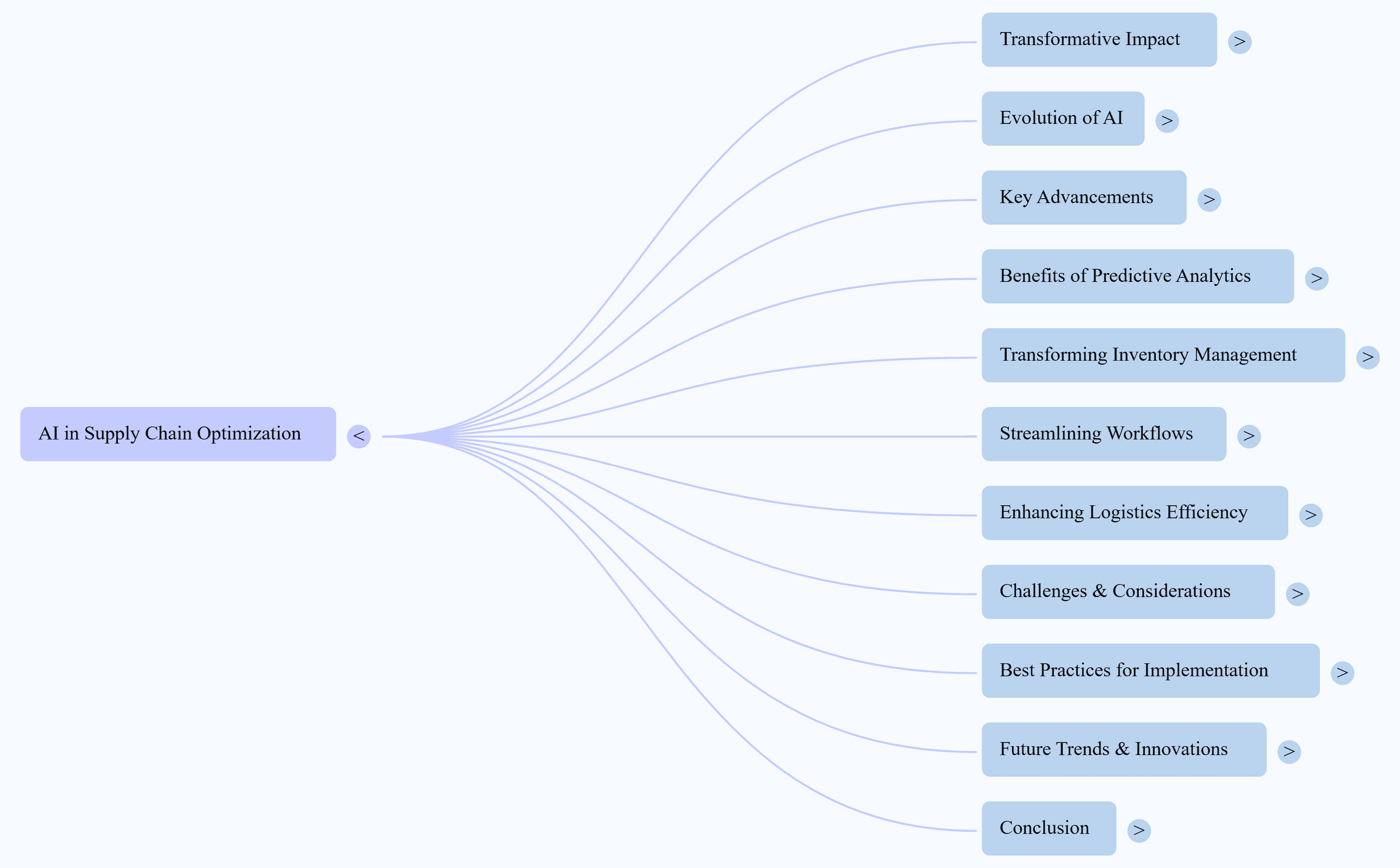
This briefing document summarizes the key themes and important ideas presented in the provided excerpts regarding the role of Artificial Intelligence (AI) in optimizing supply chain management. The central argument is that AI is revolutionizing supply chains by enhancing predictive analytics, transforming inventory management, streamlining workflows, and improving overall logistics efficiency. The document outlines the evolution of AI in this domain, highlights specific advancements and benefits, addresses challenges and considerations, and looks towards future trends. The excerpts emphasize the transition from rule-based systems to sophisticated machine learning algorithms capable of handling complex optimizations, ultimately leading to more agile, data-driven, and customer-centric supply chains.

Main Themes and Important Ideas:

1. The Transformative Impact of AI on Supply Chain Management:

  • AI is presented as a revolutionary force in supply chain management, impacting everything from inventory levels and demand prediction to logistics efficiency.
  • AI-powered systems analyze vast datasets to forecast market trends, enabling proactive decision-making.
  • The integration of AI transforms supply chains into “agile, data-driven ecosystems that adapt to market fluctuations and customer needs.”

2. Evolution of AI in Supply Chain Management:

  • The journey began in the 1950s with simple rule-based systems.
  • The 1980s saw the focus on inventory management and demand forecasting using expert systems for warehouse layout and vehicle routing.
  • The 1990s brought the rise of data mining and neural networks for demand forecasting, with retailers like Walmart as pioneers. Automated planning and scheduling in manufacturing also began.
  • The 2000s witnessed significant advancements in machine learning and optimization algorithms, leading to applications in dynamic pricing, supply network design, and real-time logistics optimization.
  • The 2010s, fueled by cloud computing and big data, accelerated AI adoption across the entire supply chain, from procurement to last-mile delivery.

3. Key Advancements in AI-driven Supply Chain Optimization:

  • Predictive Analytics for Demand Forecasting: Advanced machine learning models incorporate various variables (including social media and weather data) for accurate forecasting, leading to “significant reductions in inventory costs and stockouts.” A McKinsey study suggests AI-powered demand forecasting can reduce errors by 30-50%.
  • Autonomous Planning and Execution: AI systems can now autonomously plan and execute supply chain operations, adjusting to disruptions in real-time, including “everything from production scheduling to route optimization for delivery vehicles.”
  • Intelligent Automation in Warehouses: AI integrated with robotics revolutionizes warehouse operations, with AI-powered robots navigating, picking, packing, and predicting maintenance needs, leading to dramatic efficiency improvements. Amazon’s experience highlights the reduction in operating expenses.
  • Supply Chain Visibility and Risk Management: AI algorithms process vast data to provide end-to-end visibility, predicting potential disruptions and suggesting mitigation strategies in real-time.
  • Personalized Customer Experience: AI enables hyper-personalization by tailoring products and delivery options to individual preferences. An Accenture study indicates that “91% of customers shop with brands that offer personalized experiences.”

4. Benefits of Predictive Analytics:

  • Anticipating Market Trends: AI algorithms identify and analyze patterns in large datasets to forecast future consumer behavior and market conditions, allowing proactive strategic adjustments.
  • Reducing Risks: AI-driven predictive analytics help identify potential risks (supply chain disruptions, financial fluctuations, operational inefficiencies) before they become critical, enabling preventive measures.
  • Enhancing Supply Chain Resilience: By monitoring factors impacting the supply chain (supplier performance, transportation delays, geopolitical events), predictive analytics allow companies to develop contingency plans and ensure business continuity.

5. Transforming Inventory Management with AI:

  • AI-enabled systems provide real-time monitoring, advanced demand forecasting, and automated replenishment, leading to “substantial efficiency gains, cost savings, and reduced stockouts.”
  • AI Automates Inventory Tracking: Leveraging IoT sensors, computer vision, and machine learning for real-time monitoring of inventory levels, locations, and conditions.
  • Real-Time Monitoring: IoT sensors track inventory movement and status, including environmental conditions.
  • Computer Vision: AI-powered cameras automate scanning and recognition, reducing manual counts and identifying discrepancies.
  • Demand Forecasting with AI: Machine learning algorithms analyze vast data from various sources to identify patterns and predict future demand with high precision.
  • Optimized Replenishment Processes: AI determines ideal reordering times and quantities, minimizing excess inventory and stockouts, and can automatically generate purchase orders.
  • Cost Savings: Improved inventory levels, reduced surplus stock, minimized stockouts, and automated reordering processes contribute to significant cost savings.
  • Reduced Stockouts: Accurate demand prediction and timely replenishment ensure optimal stock levels, enhancing customer satisfaction and loyalty and reducing lost sales.

6. Streamlining Workflows through AI Integration:

  • AI automates routine tasks, enhances accuracy, and provides comprehensive operational insights, leading to cost reductions and improved efficiency in logistics and supply chain management.
  • Real-world examples highlight successful AI implementation:
  • A German manufacturer saved approximately $30 million through a data strategy aligned with business goals developed with Gramener.
  • Gramener created a digital twin for a pharmaceutical company’s drug production, resulting in $6 million in savings and improved efficiency.
  • A US manufacturing company used AI for predictive maintenance of their truck fleet, avoiding costly repairs and downtime.

7. Enhancing Overall Efficiency in Logistics:

  • AI has a holistic impact on the supply chain, increasing efficiency, cost savings, and customer satisfaction across procurement, production planning, warehouse management, transportation, last-mile delivery, and customer service.
  • Procurement: AI enhances supplier selection and management through data analysis, streamlines communication with chatbots, and helps detect potential disruptions early.
  • Production Planning: AI optimizes resource allocation and scheduling, considering various factors. McKinsey reports a potential 10-15% increase in overall equipment effectiveness with AI-enabled planning. AI also improves quality control through computer vision.
  • Warehouse Management: AI and robotics optimize picking routes and inventory placement. DHL studies indicate improved productivity and accuracy with AI-powered systems.
  • Transportation and Logistics: AI is crucial for route optimization and load planning, with IBM reporting potential fuel cost reductions of up to 25% and on-time delivery improvements of 30%.
  • Last-Mile Delivery: AI optimizes delivery schedules and routes, potentially reducing delivery costs by up to 40% and improving customer satisfaction by 30% (Capgemini). Autonomous vehicles and drones are being explored for further improvements.
  • Customer Service and Returns Management: AI-powered chatbots handle inquiries, while AI algorithms analyze return patterns to identify quality issues and optimize reverse logistics.

8. Challenges and Considerations:

  • Data Quality: Inconsistent or inaccurate data can lead to flawed analyses, necessitating rigorous data governance protocols.
  • Cybersecurity Threats: Integrated AI systems are vulnerable to cyberattacks, requiring robust digital defenses (encryption, access controls, continuous monitoring).
  • Human-AI Collaboration: Resistance to change and fear of job displacement can hinder adoption, requiring upskilling, fostering innovation, and clear communication of AI benefits.

9. Best Practices for AI Implementation:

  • Start with pilot projects.
  • Prioritize data quality.
  • Foster cross-functional collaboration.
  • Implement change management strategies.
  • Establish ethical guidelines.

10. Future Trends and Innovations:

  • Autonomous Supply Chains: AI-powered systems orchestrating end-to-end operations with minimal human intervention.
  • Edge Computing Integration: Enabling real-time decision-making at the point of action.
  • Blockchain-AI Convergence: Enhancing transparency and trust in supply networks through smart contracts and immutable ledgers.
  • Quantum Computing Applications: Solving complex logistical problems at scales beyond classical computers.
  • Predictive AI-powered Maintenance: Minimizing downtime and extending asset lifespans by anticipating equipment failures.

11. Conclusion:

  • AI is a powerful tool transforming supply chain management by enhancing efficiency and reducing costs across all stages.
  • Despite challenges like data quality and cybersecurity, the benefits of AI integration are substantial.
  • Future advancements like autonomous supply chains and quantum computing offer the potential for further innovation.
  • By embracing AI responsibly and strategically, businesses can create agile, data-driven supply chains that adapt to market changes and meet customer needs effectively.

Quotes from the Original Source:

  • “Artificial intelligence revolutionizes supply chain management by optimizing inventory levels, predicting demand patterns, and enhancing logistics efficiency.”
  • “Integrating AI transforms supply chains into agile, data-driven ecosystems that adapt to market fluctuations and customer needs.”
  • “According to a McKinsey study, AI-powered demand forecasting can reduce errors by 30-50% in supply chain networks.”
  • “Amazon reports that its AI-driven robotics have cut operating expenses in fulfillment centers where they’ve been deployed.”
  • “A study by Accenture found that 91% of customers shop with brands that offer personalized experiences.”
  • “AI supports decision-making by providing actionable insights derived from data analysis.”
  • “By forecasting future consumer behavior and market conditions, companies can adjust their strategies proactively, staying ahead of competitors and meeting customer expectations.”
  • “A 2023 study published by Link Springer shows that AI transforms traditional inventory tracking methods by leveraging developed technologies such as IoT sensors, computer vision, and machine learning algorithms.”
  • “A report by McKinsey & Company revealed that AI-enabled production planning can increase overall equipment effectiveness by 10-15%.”
  • “According to a study by DHL, AI-powered warehouse management systems can improve productivity and accuracy.”
  • “A study by IBM found that AI-powered route optimization can decrease fuel costs by up to 25% and improve on-time deliveries by 30%.”
  • “A report by Capgemini found that AI-driven last-mile optimization can reduce delivery costs by up to 40% and improve customer satisfaction by 30%.”
  • “Autonomous supply chains represent a transformative vision for the industry.”
  • “Blockchain-AI convergence promises to enhance transparency and trust in supply networks.”

This briefing document provides a comprehensive overview of the role of AI in supply chain optimization based on the provided source excerpts. Further analysis of the linked external resources could provide additional context and insights.

Ai Criteria Summary Key Impact Challenges
Evolution of AI in Supply Chain AI evolved from rule-based systems in the 1950s to today’s machine learning-driven operations, revolutionizing inventory and logistics management. Improved efficiency and accuracy in operations. High initial implementation costs.
Advancements in AI-driven Supply Chain Optimization Key advancements include predictive analytics, autonomous planning, intelligent automation, enhanced visibility, and personalized customer experiences. Reduced operational costs and enhanced responsiveness. Need for skilled personnel and infrastructure.
AI-Powered Predictive Analytics AI improves decision-making through demand forecasting, route optimization, and resource allocation, reducing waste and enhancing profitability. Better demand prediction and lower operational risks. Dependence on data quality and availability.
Transforming Inventory Management with AI AI enables real-time monitoring, automated replenishment, and demand forecasting, leading to cost savings and reduced stockouts. Optimal stock levels and minimized waste. Integration with existing ERP systems.
Streamlining Workflows through AI Integration AI streamlines operations by automating routine tasks, improving accuracy, and providing operational insights to reduce costs. Increased automation and operational agility. Resistance to change from employees.
Enhancing Overall Efficiency in Logistics AI optimizes procurement, production planning, warehouse management, and last-mile delivery, enhancing customer satisfaction and efficiency. Enhanced delivery speed and cost reductions. Complex logistics networks may limit effectiveness.
Real-time Supply Chain Visibility AI provides real-time insights across the supply chain, allowing proactive issue resolution and better decision-making. Faster response to disruptions and improved transparency. Data security and privacy concerns.
Risk Management and Mitigation AI algorithms analyze data to predict potential disruptions and suggest mitigation strategies. Enhanced resilience and risk preparedness. Difficulty in handling unexpected events.
Customer Experience Enhancement AI enables personalized customer experiences by analyzing preferences and optimizing delivery options. Increased customer satisfaction and brand loyalty. Balancing automation with the human touch.
AI-Driven Procurement Optimization AI automates supplier selection, contract negotiation, and procurement planning, optimizing cost efficiency and supplier relationships. Cost savings and improved supplier reliability. Ensuring supplier compliance and ethical sourcing.
Challenges and Considerations Issues such as data quality, cybersecurity risks, and resistance to AI adoption require strategic planning and robust implementation strategies. Long-term competitive advantage with proper execution. Addressing internal and external regulatory requirements.
Future Trends and Innovations Trends include autonomous supply chains, blockchain integration, quantum computing applications, and predictive maintenance to enhance efficiency further. Transformation into data-driven, agile supply chains. Keeping up with rapid technological changes.

The Evolution of Artificial Intelligence in Supply Chain Management

Artificial Intelligence (AI) has transformed supply chain management and logistics operations over several decades. Research shows that the journey began in the 1950s with simple rule-based systems and has progressed to today’s sophisticated machine learning algorithms capable of handling complex, multi-variable optimizations.

AI and Supply Chain in the 1980s

Early AI applications in the supply chain focused on inventory management and demand forecasting. In the 1980s, companies started using expert systems to codify human knowledge for warehouse layout design and vehicle routing tasks. 

AI and Supply Chain in the 1990s

The 1990s saw the rise of data mining and neural networks in supply chain analytics. Retailers like Walmart pioneered these technologies to analyze vast transaction data and improve demand forecasts. The 1990s also marked the beginning of automated planning and scheduling systems in manufacturing.

AI and Supply Chain in the 2000s

The 2000s brought significant advancements in machine learning and optimization algorithms. Companies began using these techniques for dynamic pricing, supply network design, and real-time logistics optimization. The advent of cloud computing and big data technologies in the 2010s further accelerated AI adoption in supply chains.

Today, AI is being applied across the entire supply chain, from procurement to last-mile delivery. Machine learning models can predict demand with unprecedented accuracy, while reinforcement learning algorithms optimize complex logistics networks in real time.


Advancements in AI-driven Supply Chain Optimization

Some advancements in supply chain optimization regarding AI are:

  • Predictive Analytics for Demand Forecasting
  • Autonomous Planning and Execution
  • Intelligent Automation in Warehouses
  • Supply Chain Visibility and Risk Management
  • Personalized Customer Experience

Predictive Analytics for Demand Forecasting

Advanced machine learning models now incorporate various variables, including social media trends and weather data, to accurately forecast demand. So this has led to significant reductions in inventory costs and stockouts. According to a McKinsey study, AI-powered demand forecasting can reduce errors by 30-50% in supply chain networks.

Autonomous Planning and Execution

AI systems can now autonomously plan and execute supply chain operations, adjusting to disruptions and changing conditions in real-time. Remember, this includes everything from production scheduling to route optimization for delivery vehicles.
Intelligent Automation in Warehouses

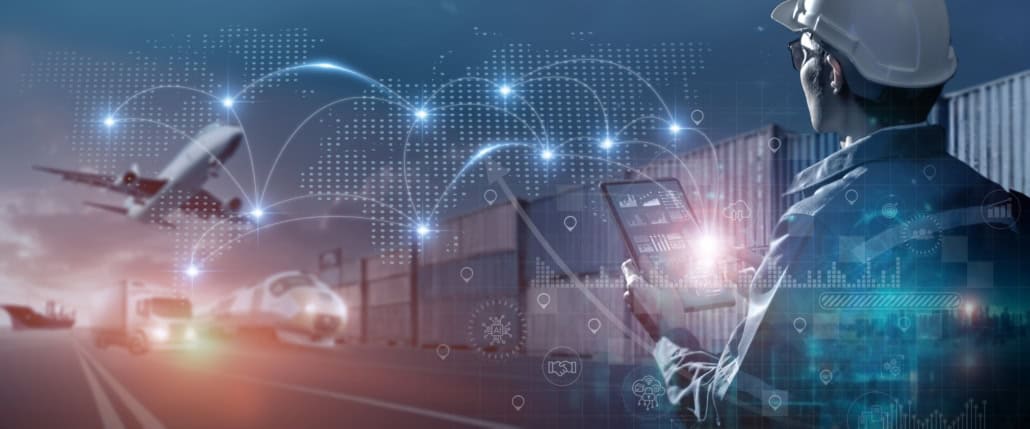
The integration of AI with robotics has revolutionized warehouse operations. AI-powered robots can navigate warehouses, pick and pack items, and predict maintenance needs, dramatically improving efficiency. Amazon reports that its AI-driven robotics have cut operating expenses in fulfillment centers where they’ve been deployed.

Supply Chain Visibility and Risk Management

AI algorithms now process vast amounts of data from various sources to provide end-to-end visibility across the supply chain. These systems can predict potential disruptions and suggest mitigation strategies in real time.

Personalized Customer Experience

AI enables hyper-personalization in supply chain operations, allowing companies to tailor products and delivery options to individual customer preferences at scale. A study by Accenture found that 91% of customers shop with brands that offer personalized experiences. 


AI-Powered Predictive Analytics: Enhancing Decision-Making

Artificial Intelligence (AI) algorithms have revolutionized how businesses manage their operations, particularly in forecasting demand, optimizing routing, and enhancing decision-making. These algorithms utilize vast amounts of data, applying complex mathematical models to accurately predict future trends and behaviors. Here’s how AI works in these critical areas:

  • Forecasting Demand 
  • Optimizing Routing 
  • Improving Decision-Making 

Forecasting Demand 

According to Forbes, AI algorithms analyze customer behavior, historical data on sales, market trends, weather patterns, and economic indicators. By recognizing patterns and correlations within this data, AI can predict future demand with high precision.

Optimizing Routing 

In logistics, AI algorithms consider traffic conditions, delivery locations, vehicle capacities, and fuel efficiency to determine the most efficient delivery routes. These algorithms use real-time data and predictive analytics to minimize travel time and costs, improving overall operational efficiency.

Improving Decision-Making 

AI supports decision-making by providing actionable insights derived from data analysis. For example, AI can suggest when to reorder stock in supply chain management, which suppliers offer the best terms, and how to allocate resources most effectively. This leads to reducing waste and maximizing profitability.


Benefits of Predictive Analytics

Here are the primary advantages of predictive analytics:

  • Anticipating market trends
  • Reducing Risks 
  • Enhancing supply chain resilience

Let’s discuss these in detail! 

Anticipating Market Trends

Predictive analytics uses AI algorithms to identify and analyze patterns within large datasets, allowing businesses to anticipate market trends. By forecasting future consumer behavior and market conditions, companies can adjust their strategies proactively, staying ahead of competitors and meeting customer expectations.

Reducing Risks

AI-driven predictive analytics help businesses identify potential risks before they become critical issues. Companies can implement preventive measures by analyzing data on supply chain disruptions, financial fluctuations, and operational inefficiencies, reducing the likelihood of significant losses. 

Enhancing Supply Chain Resilience

Supply chain resilience is crucial for maintaining uninterrupted operations. Predictive analytics enable companies to monitor and assess numerous factors impacting the supply chain, such as supplier performance, transportation delays, and geopolitical events. By predicting potential disruptions, businesses can develop contingency plans, ensuring they can adapt quickly and maintain continuity in their supply chains.


Transforming Inventory Management with AI

AI-enabled inventory management transforms how businesses track, forecast, and replenish their stock. Through real-time monitoring, advanced demand forecasting, and automated replenishment, AI delivers substantial efficiency gains, cost savings, and reduced stockouts. As a result, businesses can achieve agile and customer-centric supply chains, positioning themselves for sustained success in a competitive market.

AI Automates Inventory Tracking

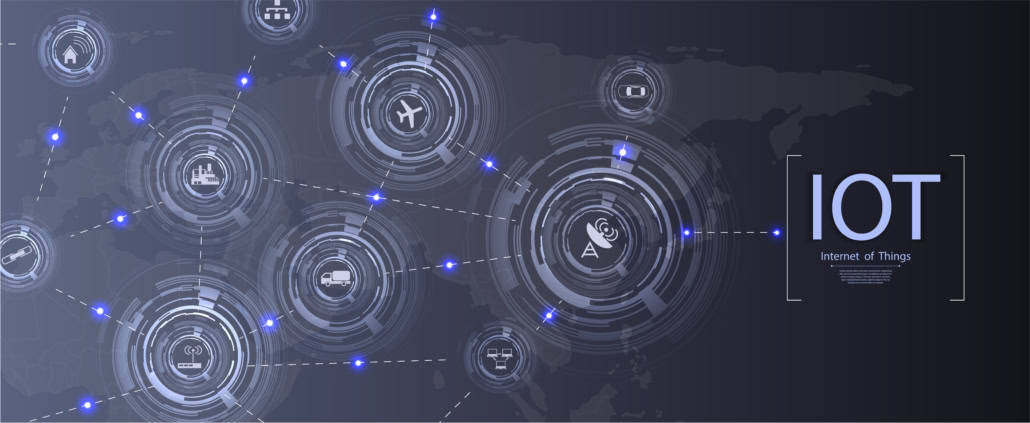
A 2023 study published by Link Springer shows that AI transforms traditional inventory tracking methods by leveraging developed technologies such as IoT sensors, computer vision, and machine learning algorithms. These technologies enable real-time monitoring of inventory levels, locations, and conditions, ensuring that businesses always have an accurate view of their stock.

Real-Time Monitoring

AI-driven systems use IoT sensors to track real-time inventory movement and status. These sensors can detect when items are added or removed from storage, their location within a warehouse, and even environmental conditions like temperature and humidity that could affect perishable goods.

Computer Vision

Integrating AI with computer vision allows for automated scanning and recognition of products, reducing the need for manual inventory counts. Cameras equipped with AI can identify and count items on shelves, track their movement, and alert managers about discrepancies or low stock levels.
Demand Forecasting with AI

AI enhances demand forecasting by analyzing enormous amounts of data from numerous sources, including sales history, market trends, social media activity, and economic indicators. Studies highlight that machine learning algorithms can identify associations that human experts might miss, leading to more precise predictions.

Machine learning models analyze historical sales data and identify patterns to predict future demand. These models continuously learn and adapt, improving their accuracy over time. For example, a retail store can predict increased demand for specific products during holiday seasons or in response to promotional campaigns.

Replenishment Processes

AI optimizes replenishment processes by determining the ideal times and quantities for reordering stock, minimizing excess inventory, and reducing stockouts. In addition, AI-driven systems can automatically generate purchase orders based on real-time inventory data and demand forecasts. 

Moreover, AI enables just-in-time (JIT) inventory management, where stock is replenished only as needed. This approach minimizes storage costs and reduces the risk of overstocking or obsolescence.

Cost Savings

By improving inventory levels and lowering the need for surplus stock, AI helps businesses save on storage and holding costs. Accurate demand forecasting minimizes the risk of stockouts and overstocking, further reducing operational expenses. Automated reordering processes also minimize administrative costs and improve procurement efficiency.

Reduced Stockouts

By accurately predicting demand and ensuring timely replenishment, AI helps maintain optimal stock levels, enhancing customer satisfaction and loyalty. Reduced stockouts also mean fewer lost sales opportunities and better overall business performance.


Streamlining Workflows through AI Integration

AI is revolutionizing logistics and supply chain management, offering companies new ways to streamline operations and reduce expenses. AI is transforming how businesses manage their logistics by automating routine tasks, enhancing accuracy, and providing comprehensive operational insights. Let’s examine a few real-world examples of successful AI implementation in logistics:

A German manufacturer partnered with Gramener, a global AI and data science firm, to create a data strategy aligned with their business goals. This collaboration led to impressive cost savings of approximately $30 million. 

In a separate project, Gramener developed a digital twin of a pharmaceutical company’s drug production process. So this allowed the client to exert greater control over manufacturing and make on-the-fly adjustments based on data-driven insights. The result was $6 million in savings and improved production efficiency.

In the United States, a manufacturing company employed an AI solution for predictive maintenance of their truck fleet. By analyzing engine data over time, they could foresee potential issues before they occurred, avoiding costly repairs and minimizing unexpected downtime. The approach kept their trucks operating efficiently and economically while preventing delays caused by mechanical problems.


Enhancing Overall Efficiency in Logistics

Artificial Intelligence (AI) has revolutionized supply chain operations, transforming every stage from procurement to distribution. This holistic impact has increased efficiency, cost savings, and improved customer satisfaction across the entire supply chain ecosystem.

Procurement

In the procurement phase, AI has significantly enhanced supplier selection and management. Machine learning algorithms can analyze substantial data on supplier performance, market conditions, and risk factors to identify the most suitable partners. 

AI-driven chatbots and virtual assistants streamline supplier communication, automating routine inquiries and negotiations. This not only saves time but also ensures consistent and accurate information exchange. Furthermore, AI helps detect potential supply chain disruptions early, allowing companies to mitigate risks and maintain business continuity proactively.

Production Planning

In production planning, AI optimizes resource allocation and scheduling. To create efficient production plans, advanced algorithms consider multiple variables such as demand forecasts, inventory levels, production capacity, and maintenance schedules. A report by McKinsey & Company revealed that AI-enabled production planning can increase overall equipment effectiveness by 10-15%.

AI also enhances quality control processes. Computer vision systems equipped with deep learning algorithms can detect product defects with greater accuracy and speed than human inspectors. This improves product quality and reduces waste, resulting in cost savings and increased customer satisfaction.

Warehouse Management

AI has transformed warehouse operations through intelligent automation. Robotics and AI work together to optimize picking routes, reducing the time and distance warehouse staff travel. According to a study by DHL, AI-powered warehouse management systems can improve productivity and accuracy.

AI algorithms also optimize inventory placement within warehouses, ensuring fast-moving items are easily accessible and storage space is utilized efficiently. Predictive analytics help anticipate demand fluctuations, allow for proactive inventory management, and reduce the risk of stockouts or overstocking.

Transportation and Logistics

AI is essential in route optimization and load planning in transportation and logistics. Machine learning algorithms analyze real-time weather conditions, traffic data, and historical patterns to find the most efficient delivery routes. A study by IBM found that AI-powered route optimization can decrease fuel costs by up to 25% and improve on-time deliveries by 30%. 

Last-Mile Delivery

AI has significantly improved last-mile delivery, the supply chain’s most challenging and expensive part. Machine learning algorithms optimize delivery schedules and routes, considering traffic patterns, delivery time windows, and package characteristics. A report by Capgemini found that AI-driven last-mile optimization can reduce delivery costs by up to 40% and improve customer satisfaction by 30%.

AI-powered autonomous vehicles and drones are also being tested for last-mile delivery, promising to reduce costs and delivery times further. While still in the early stages, these technologies have the potential to revolutionize urban logistics and improve service in remote areas.

Customer Service and Returns Management

AI has transformed customer service in supply chain operations through intelligent chatbots and virtual assistants. These AI-powered tools can handle various customer inquiries, from order tracking to product information, providing instant responses and freeing human agents for more complex issues. 

In returns management, AI algorithms analyze return patterns and reasons to identify potential quality issues or misleading product descriptions. This data-driven approach helps companies reduce return rates and improve customer satisfaction. AI also optimizes reverse logistics, determining the most cost-effective way to handle returned items: restocking, refurbishing, or recycling.


Challenges and Considerations

Data quality poses a hurdle in AI-driven supply chain optimization. Inconsistent data Inaccuracy can lead to flawed analyses. Organizations must implement rigorous data governance protocols to ensure the integrity of their information sources.

Cybersecurity threats loom as AI systems become more integrated into supply chain operations. AI algorithms or connected infrastructure vulnerabilities could expose sensitive business data or disrupt critical processes. Companies must fortify their digital defenses, employing encryption, access controls, and continuous monitoring to safeguard their AI-powered supply chains.

Human-AI collaboration presents both opportunities and challenges. While AI can augment human decision-making, resistance to change and fear of job displacement may hinder adoption. Organizations should focus on upskilling their workforce, fostering a culture of innovation, and communicating the benefits of AI integration to alleviate concerns and maximize synergies. 
Here are the best practices for implementation of AI in the supply chain:

  • Start with pilot projects: Begin with small-scale implementations to demonstrate value and gain organizational buy-in before scaling up. 
  • Prioritize data quality: Invest in robust data management systems and processes to ensure reliable inputs for AI algorithms. 
  • Foster cross-functional collaboration: Bring together supply chain, IT, and data science experts to develop holistic solutions. 
  • Implement change management strategies: Provide training and support to help employees adapt to new AI-driven processes. 
  • Establish ethical guidelines: Develop policies for responsible AI use, addressing bias and transparency.

Future Trends and Innovations

Autonomous supply chains represent a transformative vision for the industry. AI-powered systems could orchestrate end-to-end operations with minimal human intervention, from demand forecasting to inventory management and logistics optimization.

Edge computing integration will enable real-time decision-making at the point of action. By processing data locally on IoT devices, AI algorithms can respond to supply chain disruptions or opportunities with unprecedented speed and agility.

Moreover, Blockchain-AI convergence promises to enhance transparency and trust in supply networks. Smart contracts powered by AI could automate complex multi-party transactions, while blockchain’s immutable ledger ensures data integrity and traceability.

Quantum computing holds the potential to revolutionize supply chain optimization. As this technology matures, it could solve complex logistical problems at scales beyond the reach of classical computers, unlocking new efficiencies in routing, scheduling, and resource allocation.

Furthermore, predictive AI-powered maintenance will minimize downtime and extend asset lifespans. Machine learning models will analyze sensor data to anticipate equipment failures before they occur, enabling proactive maintenance and reducing supply chain disruptions.


Conclusion

AI is transforming supply chain management, offering powerful tools for optimization across all stages. From demand forecasting to logistics and inventory management, AI enhances efficiency and reduces costs. While challenges like data quality and cybersecurity exist, the benefits of AI integration are substantial. 

Companies can have more innovative solutions as technology advances, including autonomous supply chains and quantum computing applications. By embracing AI responsibly and strategically, businesses can create agile, data-driven supply chains that adapt to market changes and meet customer needs effectively.